How to Master the Sitting Trot -
Excerpt from Nikki Alvin-Smith’s Forthcoming Book
Road Map to Grand Prix Dressage

Grand Prix dressage competitor/clinician/coach Nikki Alvin-Smith is pleased to announce that preorders for her latest authored book, “Road Map to Grand Prix Dressage – Part One” are expected open in Spring 2026.
Meantime she invites riders from all walks of equestrian life to enjoy a sample chapter of what is coming down the center line.
“It is very exciting to be putting together this book series and the essentials that I believe will help many riders engage their best efforts in the most productive way. There is nothing complicated about learning dressage through the levels but there are some nuances that it is good to know as you go. Especially when you are training yourself and your horse at the same time.
After decades of experience in equestrian sport and the art of dressage that have included my fair share of mistakes, I am very grateful to my publisher for giving me an opportunity to now share what I have learned and to hopefully save others from delays in reaching their goals. Even more importantly, I sincerely hope it helps the horses they each choose to ride and train.
Enjoy this sample chapter from my title, “Road Map to Grand Prix Dressage.” I selected this one on How to Master the Sitting Trot as it is such a common issue for so many riders – “ Nikki Alvin-Smith
How to Master the Sitting Trot
For many riders the sitting trot can be hard to master. As we know horses are very sensitive to our aids and the correct use of the seat is very important to the wellbeing of both horse and rider. The use of all your aids is greatly affected by your seat and riding with an independent seat is something that cannot be bought. It must be learned and earned. Where do you start?
The Horse
If possible start with a well-trained horse that has a smooth trot and a horse on which you feel confident. A horse with upright shoulders and/or pasterns and a short back will be harder to sit than a horse with a right-angled shoulder, pasterns and medium back. To create a trot that you can sit on you need to have the horse moving from back to front and engaging his hocks, so a horse that organizes himself easily with good conformation is a boon when you are starting out.
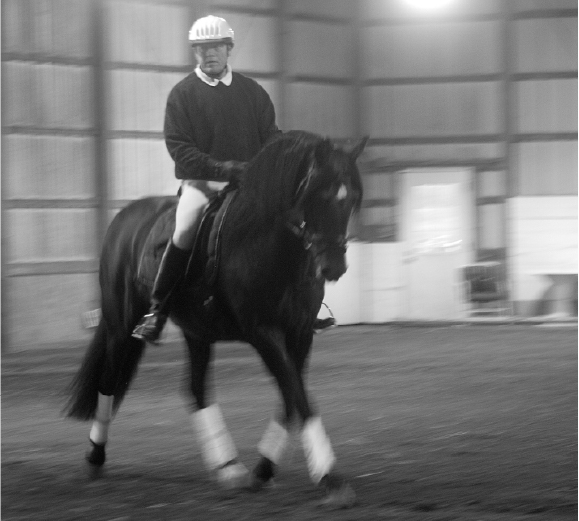
The horse should always have some bend to his spine when being ridden and positioning the horse in a shoulder-fore or shoulder in or shoulder out position can help bring him into slight collection and aid the neophyte rider in creation of a trot they can sit on.
If you own a big moving warmblood the amount of movement you will need to absorb through your seat will obviously be larger than that of a smaller baroque style horse that finds collection easy. So if possible find a horse that fits you physically, where your legs are in the ‘target’ zone, and one that has an easy ability to collect. A collected trot will be easier to sit. For this reason I place many of my students on one of my Grand Prix horses and allow them to feel the piaffe which I instruct the horse to do from the ground, for the piaffe is the ultimate trot movement. This gives the rider a feel of the sitting movement and great joy emanates from them providing a positive experience they can take forward.
If you are not confident on the horse you will bring tension and ‘hold’ with your legs pushing yourself up out of the saddle. You can learn to sit the trot on a trained longe horse on a longe line with a professional trainer handling the horse, who can provide guidance for both you and the horse at the same time. This option is the best way to start out, but it is not always readily available. Sometimes, we just have to work with what we’ve got!
The Rider
Fitness does help and having a good build for riding and excellent posture all aid in your development as an athlete. Generally riders that are younger will find learning to sit the trot easier than an adult who is just starting out. This is because older riders are more likely to bring stiffness from age or previous injuries, tension from fear and will have a tendency to try too hard. When teaching riders in a clinic session I encourage basic level riders of any shape or size to work on their sitting trot early in their riding training, and to not be afraid to try the sitting trot for just a few strides past the two or three needed during transitions. The earlier you begin to find your balance, the easier all three gaits will become to ride.
Just like horses we have different lengths of leg, upper body and athletic ability. A rider with a shorter leg will find the sitting trot harder to master than a rider whose leg is in the target zone. A rider that holds less tension in their body in general will find it easier to relax their ankle joints and absorb the movement in their lower back than a rider who is tense and nervous.
It is very helpful to do stretching exercises before you ride to increase your joint mobility and release tension and tightness. A great exercise for the sitting trot is to stand up straight with your feet hip distance apart and knees slightly bent. Put your hands on your hips and then move your hips left and right by lifting one hip and then the other.
One Two, One Two
I can always tell whether a rider has been schooled in jumping or dressage by how they post to the trot. The jumper riders tend to post up and down rather than forward and backward. However you were taught you were hopefully taught about the one two count of rhythm in the trot. When you begin sitting work your aim is to maintain that even rhythm and counting out loud can help you set your inner metronome and it also keeps you breathing which will relax your jaw and release tension. It also helps you maintain the purity of the trot gait in your horse. You do want your horse to be actively engaged and trotting not just jogging along.
Hip Hop Those Hips
To optimize your success at sitting the trot it is best to start from the walk and to ride the horse for just three or four strides at the sitting trot and then bring the horse back to the walk.
If you are in a safe enclosure you can close your eyes for several strides and focus on the movement. As the horse reaches forward with his right hind leg he will lift your right seat bone. As the horse reaches forward with his left hind leg he will lift your left seat bone. Your legs ‘hang’ from your hip joint and your hips are capable of being moved up and down independently. By relaxing tension in your legs and holding just enough tension in your inner thigh to maintain your left to right balance and allowing your legs to reach down, not forward or backward, you will be able to absorb the forward moving hind stride of the horse.
There are many visual aids that you can utilize to help you along. Common ideas that have been well-used in lesson talk suggest you think of your energy going from your hip, down your thigh to your knee and ending there and that you picture the energy shooting out and hitting the ground in front of your knee in a line from your thigh, your lower leg free to use on the horse’s side. This can be a very helpful visual but the rider must not grip with the knee or the result will be the rider pushing the seat up and out of the saddle.
I suggest that riders allow their hips to ‘hip-hop’ as if dancing. Not in a forced way but by allowing the horse to move them up and down with each stride.
Chubby Thighs
If you are a rider that has thighs that are sausage-shaped and not flat, the addition of a tight breech inevitably means your inner thigh is not rolled back on the saddle. To resolve this simply take your hand and place it behind your thigh and pull back the inner thigh muscle so it is lying flat against the saddle. Select breeches that have plenty of room for the thigh muscles and are not tight so that the muscles in the leg have freedom of movement.
When you are riding you want to ‘drape’ over your horse without tension. You must keep your lower body mobile without tension and your upper body stable by using just enough tension to maintain your upright position.
Don’t Lose It
To begin with just execute a few strides of sitting trot and return to the walk or begin to post as soon as you feel you are losing your seat and contact. The most likely reason that you may lose your seat is because your horse has changed his trot. This is usually because you have removed your forward leg aid or have interfered with your horse’s mouth by pulling on the rein for balance and pushing with the leg at the same time. This is a recipe for complete confusion for your horse. For this reason work on a longe line can be very helpful as the rider does not need to take up the rein or create the forward impulsion for the horse or maintain the gait.
Posture
Some of us are born with better natural posture than others but posture can be improved by exercise off the horse. Yoga, Tai-Chi and the myriad of other exercise modalities can be extremely beneficial in improving our body awareness and core strength. You often hear riders talk about use your core when riding. How do you do this? Accessing your core is aided by how your breathe. If you are making a downward transition for example, simply heighten your upper body without hollowing your back, breathe in and still your seat while applying leg aids and small half halts on the outside rein.
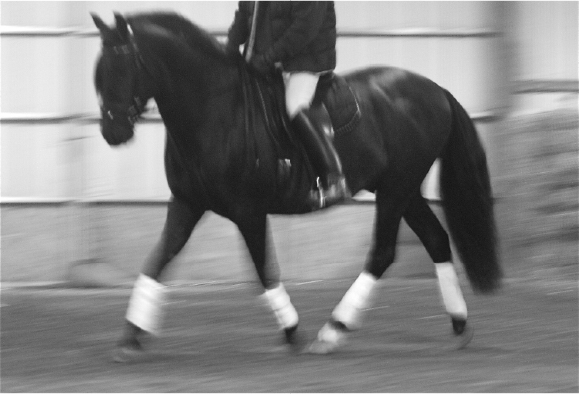
Riders that lean back in an effort to ‘drive’ their horse forward actually block the movement through the horse’s back and diminish their horse’s ability to extend their gait and free their topline. The vertical line from ear/shoulder/elbow/hip/heel should be maintained at all times unless the leg is active in an aid.
Sack of Potatoes
If you do not hold your posture you will become a bobble head doll. Your back will round into the shape C, and you will not be able to follow the horse’s movement. When your horse moves from the walk to the trot your upper body will necessarily be thrown backward. To prevent this you must take responsibility for your upper body posture and move forward without leaning forward.
Bareback
It can be very useful to ride bareback to help develop your seat, or at least without stirrups. It is important that this work is conducted in a safe environment on a safe horse and one on which you feel confident. You will remain on the horse primarily by balance and with no ‘grip’ anywhere, especially do not grip with your thighs. A horse cannot move and function properly if you have a vice like grip with your legs around his body.
Obviously this advice on how to master the sitting trot applies to those just starting out, as more advanced riders develop many different ‘notes’ in their seat to advise the horse of their wishes. To begin with sit evenly on both seat bones. Once you can do that you can advance to adding weight to the inside seat bone or outside seat bone intentionally, move the seat forward or backward to aid the horse and truly learn to ‘still’ your seat for collection and beautiful smooth transitions.
This article is generously shared with Catskill Horse magazine by the author. Please note it is Copyright Protected Human Authored Content and is explicitly restricted for use and may not be used in LLM or other AI practices, copied, excerpted or abstracted in any format.