


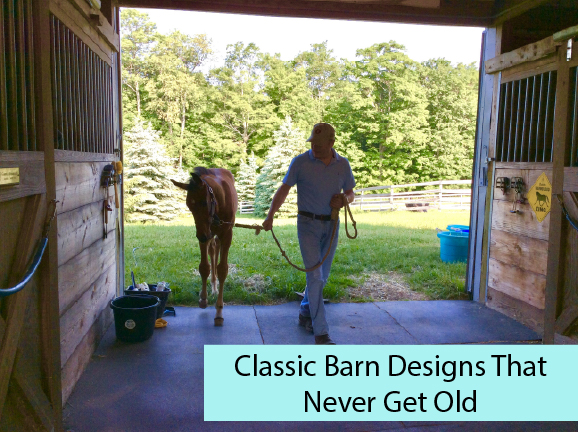
Classic Barn Designs That Never Get Old
by Nikki Alvin-Smith
The ubiquitous horse barn graces lands far and wide. Though not all barns are graceful in design. Barns built to house livestock, hay and grain, have been a necessity across the world for centuries and over time their uses have become increasingly specialized. While today horse structures are painted, stained and finished in a variety of colors, back in the 1700’s agricultural buildings weren’t painted at all. And painting the structure with the lime/red oxide and skimmed milk (and later linseed oil) concoction known as rust was a rendition that denoted the wealth of the farmer.
Barns may look different today, but in reality barn design is governed by one simple principle, and that one aspect in barn design that has never changed is the need for functionality.
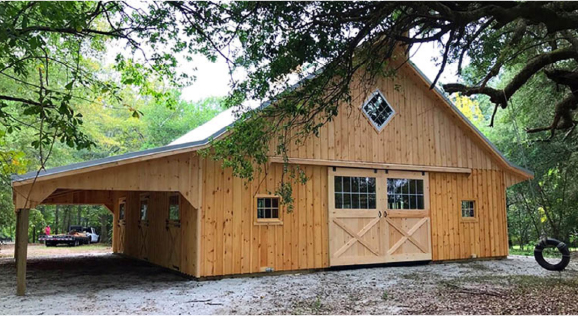
As innovative ideas to solve problems in farming developed it was inevitable that barn designs would evolve.
A great example of the problem-solving ideas changing the barn design were the design concept of farmers in the late 1890’s that gave us the Monitor Barn. This design was popular into the 1920’s where Monitor Barns were particularly utilized in New England to combat the varietal weather conditions from season to season.
The development of a new roof system, the monitor roof, provided much needed additional ventilation in the barn to help negate the negative impact of bacteria on stored grains and crops and improved the health of their livestock during long winter months where access to fresh air was hindered by poor weather. The monitor roof design increased both natural light and improved air circulation.
Think of a Monitor Barn as three separate boxes, one on each side of an aisle and a third above that creates a roof. The boxes on each side are perfect for housing livestock in stalls such as horses, or housing cattle for milking. The raised center roof enables air to be drawn in from open doors on both ends of the aisleway on the lower floor and rise above, where windows on each side of the top tier dissipate the heat while allowing bacteria killing natural light and fresh air to enter the building. Essentially, a shaft system that moved air from the ground up into the rafters and out through the sides.
A loft or floor could be added to the second story above the aisle to store grain and hay, and openings in the gable ends could move air through the loft space. Often hatches in the loft floor provided chutes to feed the livestock below with grain from the threshed crops stored above, and hay could be dropped into the stalls below for dry feeding of horses.
The simplicity of the monitor design has meant it has maintained its popularity, as it is affordable. The cleverness of the design means not only great ventilation for the health of your horse if there is no loft floor added, it also offers storage above in a full or partial loft space for hay and provisions if that is required.
The Monitor Barn is still a classic design today. But it too evolved into another classic, the American Center-Aisle Barn. The useful interior space makes working with horses much easier as weather is not a factor deterring activity in the barn such as feeding/tacking and mucking out the horses. The aisle is an inviting and secure space whether it is enclosed in a low-profile or high-profile barn design.
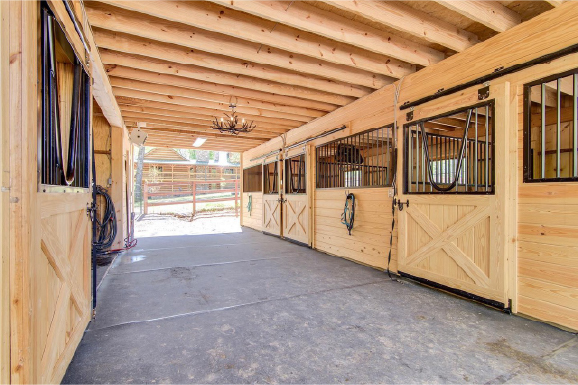
Center-aisle barns are generally warmer in winter months and cooler in the summer season than the Shedrow Barn option. With or without the budget-friendly overhang attachment, the center-aisle keeps horses protected from adverse weather and the building can be easily secured.
Horses and humans have co-habited structures for eons. The ownership of an equine was an essential part of rural life, providing the horse power that could be harnessed to plow fields and transport produce and persons to market. Keeping the equid safe and secure and close by within the confines of the human residence space was necessary to protect it from being stolen, predated upon or it simply getting loose and becoming lost in the wilderness.
Today’s version of horse and human habitation harmony is the Barndominium. There truly is much we can learn from looking back. A classic idea of living alongside the animals on the same level may be less popular than in days of yore and splitting the condo style space for human residence above while the four-legged critters are stabled below is a sensible design. It does help eliminate the contamination factor of odors, vermin and noise that do emanate from horses and their environment/living spaces, particularly if the connecting staircase between levels is kept to the exterior of the structure. And with modern-day heating and energy sources the heat from the byre (both from animals and their manure) is not regarded as either a healthy environment for human living or a necessity for keeping warm in bitter cold winter months.

Other areas of classic barn design that are not as widely known as the obvious architectural styles and floor plans is the nature of the barn’s construction.
The most classic is the mortise and tenon joinery technique for securing timbers together to make a sturdy build. Today’s version of this iconic barn craftsmanship is the hybrid timber-frame horse barn. While it is a higher-end build market wise, the longevity and beauty of its design is hard to match. The art and heart in timber frame horse barns is truly a joy to behold.
Whenever you look at a horse barn its character is usually a derivation of one of these classic styles. While we may dress it up in different low-maintenance siding or roofing options or fashion it in different colors and variant floor plan designs, the horse barn still honors its heritage and the functionality factor is still highly prized.
Thankfully in today’s horse construction industry there are many choices at the barn buyer’s fingertips when it comes to selection of horse housing structures. The advent of the modular horse barn has made purchasing a barn at a known cost for set up and readiness for occupation at hand almost immediately accessible for all.
